Showing posts with label henri cartier-bresson. Show all posts

Monday, January 3, 2011

Missing Persons: Behind the Scenes

By Eric Seals
Staff Photographer
Detroit Free Press


Shooting and producing video at the Detroit Free Press has often involved searching for features or slice-of-life stories that let me be creative and have fun telling a story, while constantly challenging myself. Sometimes, however, I like to produce stories that have a newsier edge to them, in order to mix things up and push me out of my comfort zone.

Working on this piece, "The Search for Missing People in Detroit," was another opportunity for me to try that. Here's what went into planning, shooting and editing this video.

Our police reporter, Gina Damron, had started working on a story about a new Missing Persons Unit inside the Detroit Police Department. The assignment was given to me to spend a couple of days on it, turning it into a 1:30 video piece for Web and the local CBS affiliate and stills for the newspaper. After spending the first day with the officers, based on the access I was given, the comfort level we had with each other and seeing the potential of a good story developing, I wanted to pursue it harder and work it into a longer piece.

Before I got involved, Gina had already made contacts and talked with a few victims of people missing in the city. She told me the story about Sandrew King (pictured) and how when he talked about his missing grandfather, he was riveting. The way he told his story took you into the void inside him and the lack of closure he still feels.

This is one of the benefits of working with a good reporter who also understands the power of good visual storytelling, what’s involved in the process and what it takes to pull it all together.

I sat Sandrew down in front of a plain, non-distracting background, lit him with an octagon softbox (with four 85 watt CFL lights) and we both interviewed him. We asked questions that got him to get into his feelings about the night his grandfather disappeared, the loneliness and lack of closure he and the family felt the past year. We got him to recount his search for him in abandoned homes in Detroit, as he wondered if he was still alive.

Sandrew was that type of interview for me that is usually hard to get, where a person is just so expressive, with emotion in the voice and dramatic pauses (and not the kind where you know someone is going overboard, playing to the camera). He was just real genuine in talking with us to the point where he just forgot about the softbox and all my gear around him. He was on a mission to let others know the emptiness that is still inside him. “I wouldn’t wish this kind of feeling on my worst enemy,” he said towards the end of our time with him.

The emptiness and emotion in this piece was powerful to convey and a critical element in holding the viewer glued throughout the 4:37 piece. A book I’ve read three times and recommend, talks about emotions as being an important element that can make us all better storytellers. It's called “In The Blink of An Eye” by legendary film editor Walter Murch.

Murch asks, “How do you want the to audience to feel? If they are feeling what you want them to feel all the way through the film, you’ve done about as much as you can ever do. What they finally remember is not the editing, not the camerawork, not even the story -- it’s how they felt.” He says in film editing, and I’d say in shooting as well, that emotion, story and rhythm come before anything else in the frame or the timeline.

Throughout the shooting process and before sitting down to edit in Final Cut, I was constantly thinking, asking myself what I had and what direction I was steering this piece in, and formulating its structure. Did I have enough b-roll? Did I have anything to cover when Sandrew talks about the emptiness he feels? Did I need to do more active interviewing with the police?

I’ve learned from others that the collaborative process between videojournalists and the print reporters we work with is very important and special. There’s no doubt that as visual storytellers, we have a big stake in the final outcome and the look or style of the piece. Working with Gina and other reporters at the Free Press it is always about STORY -- not my story or her story, but the viewers’ story. No matter how short or long a piece is, if we are not in tune together with structure and bouncing ideas off each other for both the written and visual piece, the work will fall apart or not be anywhere near as good as it could be.

The idea for narration didn’t enter my mind until I was halfway done shooting. There are many opinions out there about narrating. Many people don’t care for it, claiming, “I don’t want to sound like those TV guys.” Others prefer using text. For me narration can work well, especially in a complicated piece. Narration really helps tie or bridge things together, it shortens the overall length of the piece and with good (but short) script writing and enunciation, it can really help get the viewer to understand the story quicker. Good examples can be found everywhere, just look at some of the really nice work produced by Frontline, NOVA, ESPN, and HBO documentaries.

I’ve been doing video storytelling for two-and-a-half years at the Free Press. Often in the past after shooting a piece, I’d sit in front of a 30-inch monitor staring at a Final Cut timeline that just as well could have been a big table with lots of jigsaw puzzle pieces all over it. I’d usually say something like, “OK, now what the hell do I do?” I’d have no good sense of story, or structure or what I'd want to say. It was as if I was just out gathering stuff: just making pretty visuals and getting good crisp audio.

In the past year I feel like I’m just starting to understand the story structure and what I want to say before the edit. For others this might be a no-brainer, but for me there are so many balls I juggle all the time -- from a constantly changing story, the technical issues, the visuals, the learning curve -- that add up to a big commitment of time and energy. When the story arc starts to unfold in front of you, it’s a lot more gratifying than sitting in a dark video editing room waiting on an epiphany that we all know very rarely shows up.

As with many things we do in this business, we are never completely happy with the finished product. There are aspects of this video I’d love to change in hindsight, from incorporating less video at the beginning of Sandrew holding his grandfather's picture to perhaps ending it with the camera looking up at the bare trees. Those ideas and others came from seeking out opinions on my edit, keeping an open mind, and seeking and learning from constructive criticism. I’m always looking for tips from colleagues at the Free Press and others whose storytelling I respect at newspapers and TV stations across the country.

So let me ask you -- did the "Missing People" video hold your interest the whole way through? Did it leave you wanting to know more than I told you in the 4:37 piece? How do we balance the short time element of video storytelling on the Web with trying to answer questions that will be raised by the viewer? How can we stay committed to good storytelling without letting the piece drag on and on?

Do emotions (happy or sad and reflective) play an important role in the stories you tell or in the videos you watch? Just like shooting for Cartier-Bresson's decisive moment in a still image, we need people to feel something when they watch what we do. But should emotion supercede the story or the rhythm of the piece?" Let us know your thoughts.


Look for more of Eric Seals' videojournalism on KobreGuide's Detroit Free Press channel.

Sunday, January 2, 2011

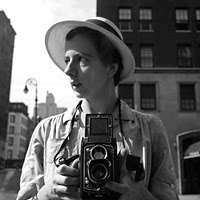
Discovering Vivian Maier

She may be the best photographer you never heard of.

Starting in the 1950s, Vivian Maier shot over 100,000 pictures -- mostly of Chicago street scenes -- but she recently went to her grave with none of her work published or exhibited. In fact, about a third of her images were still on undeveloped rolls of film. Acquaintances knew her simply as a reclusive French immigrant who worked as a nanny, and who happened to take a lot of pictures. She discreetly and expertly chronicled Chicago life for decades, in candid shots clearly inspired by Henri Cartier-Bresson and his ilk, but apparently never showed the photos to anyone. They remained stashed in boxes.

The treasures came to light in almost storybook fashion -- bought at an antiques auction by a young real-estate agent who had no formal photography training, yet recognized something special about them. The auction house had acquired them from a storage facility that had sold them off when the bills weren't paid.

Though John Maloof had never even heard the term "street photography," his purchase proved serendipitous. He began scanning and developing the prints, a project that is still in progress. The photos inspired him to try his hand at taking pictures himself: "I bought her same camera [a Rolleiflex] and took to the same streets, soon to realize how difficult it was to make images of her caliber. I discovered the eye she had for photography through my own practice."

Maloof thought to Google Maier's name, which he found written on photo-lab envelopes, a year after his purchase. But by then it was too late. Her obituary was published the day before his search. (It made no mention whatsoever of her photography.)

However, from talking to families Maier worked for, and the camera shop she frequented, Maloof subsequently discovered that "Vivian came here from France in the early 1930's and worked in a sweat shop in New York when she was about 11 or 12... She was a socialist, a feminist, a movie critic, and a tell-it-like-it-is type of person. She learned English by going to theaters, which she loved. She wore a men's jacket, men's shoes and a large hat most of the time."

Maloof started a blog devoted to Vivian Maier and his quest to establish her reputation among the pantheon of celebrated mid-20th century street photographers. Local media recently picked up the story -- including WTTW TV's Chicago Tonight and Chicago Magazine.


The first exhibit of her work, at the Chicago Cultural Center -- 80 prints, both black-and-white and color -- goes on display from January 8 to April 3.

According to Maloof:
"There's still a good 90,000 negatives to scan and a few hundred B&W rolls to develop. Not to mention about 600 undeveloped color rolls. I've also safely archived over 3000 of her prints...Over the course of scanning her work I've discovered that Vivian traveled the world in 1959. She visited and photographed places like Egypt, Bangkok, Thailand, Taiwan, Vietnam, France, Italy, Indonesia...the list goes on. Something also notable is that she traveled alone."
A book of her work will be publshed this year, and Maloof is raising funds for a documentary, "Finding Vivian Maier."


Lots to look forward to. Critics have favorably compared her work to icons such as Lewis Hine, Berenice Abbott, Eugene Atget, Walker Evans, Robert Frank, Harry Callahan, Aaron Siskind, Diane Arbus, Lisette Model and Helen Levitt. Please take a look at Vivian Maier's oeuvre, and let us know if you think it's in the same league as images by those top street photographers of that era.

Wednesday, June 10, 2009

Moving Movie Posters, Living Mag Covers, Frame Grabs, and the Big Red One

The Red One digital cinema camera, which costs as much as a car, enables you to grab crisp high-resolution still frames from video, blurring the distinction between moments and motion. Its 24-frames-per-second 9.4-megapixel capability eclipses even the fastest motor drives.

Alexx Henry created a series of living movie posters with one, and documented the process (below).
"I really believe this is the future and I’m super thrilled to be a part of the revolution. If you haven’t seen this yet, it’s very cool if it’s done right. What begins as a still image suddenly comes alive when the characters move, perform an action, and then resolve back to the poster frame. If you thought the portraits and newspapers from Harry Potter were the future, then look no further."


... and here are the results of that shoot:

“Teacher’s Pet”

“Diplomacy!”

“Students Have No Class”

***
Though the Red One is (at least for now) too big, not to mention too expensive, for in-the-field videojournalists, Canon, Nikon and Panasonic have all developed hybrid cameras that enable you to shoot both high-quality stills and video. A camcorder's ability to produce high-res frame grabs are an important consideration, since it cuts in half the amount of equipment you need to shlep to bring back video and stills from an assignment. But it carries with it ethical, aesthetic and philosophical considerations.

Henri Cartier-Bresson's "decisive moment" is no longer frozen in time, but now one of a series of points on a timeline. This may sound inconsequential, but in fact relates directly to the contrasting considerations of a video and a still shooter. At the most basic level, when you're shooting video, you're not trying to find just the right image, but rather the right sequence of movements, events, interactions. You want to follow your subject from point A, through B, to C. If you get lucky, one of those thousands of frames will distill the essence of your story -- but not necessarily!

We probably know better than most how infrequently even the best videos contain even a single still image that embodies the whole, since for every video story we post on KobreGuide, we actively search for one image that best represents it. And yet how elusive those single images are!

For "Turtle Man," to use but one small example, we wanted so badly to show you a still that encompassed both the subject's big toothless grin AND a closeup of a snapping turtle he's caught. The videographer did a terrific job by showing both -- but, except for long shots, never in the same frame! Ditto for other video stories we've showcased about dual subjects -- teachers and students, doctors and patients, and so on. A still photographer would have captured both in the same frame, but a videographer is more likely to pan or cut from one to the other, and is not looking for that one quintessential, balanced, harmonious microsecond.

For a single subject, however, there are instances when frame grabs do have an advantage.

That photo portrait of actress Megan Fox on the cover of this month's Esquire isn't a photo at all, but rather a video frame -- courtesy of shooter Greg Williams and a technique he's dubbed "Motos" (moving photos), again using that magical Red One.

According to the magazine:

"It allowed her to act," Williams says. "She could run scenes without being reminded by the sound of a shutter every four seconds that I was taking a picture. As in still photography, a lot of it is capturing unexpected moments. This takes that one step further." He then went back and pulled out the best images, which you can see in Esquire's June issue. Plus, there's a fantastic by-product: Even though we made the film to get the stills, we were left with ten bewitching minutes of footage of a beautiful woman. We edited it down to a mini movie, which is now available right here.
(Caveat: Be forewarned, this is not strictly videojournalism, but rather "loosely scripted footage with Fox — getting out of bed, rolling around on a pool chair, eating BBQ." You get the idea.)

On a more serious note, Harvard's Nieman Labs incisively analyzes the "frame-grabbing" trend, and offers these helpful considerations (with underlying explanations):

+ Frame grabbing works better on a camcorder with a “progressive” shooting option.

+ Frame grabbing works better at higher shutter speeds than would be used for shooting video.

+ Frame grabbing might require a video light rather than a strobe in low light

***
We've come a long way technologically since David Leeson (who recently left the Dallas Morning News) returned from Hurricane Katrina extolling the virtues of frame grabs from a HDV camera, but his subsequent observations were prescient:
Today, we still call them frame grabs. Tomorrow we will call them what they really are – photographs. The end result is that we do not have to sacrifice our legacy of still photojournalism simply because the medium has changed. We can move forward to a new era of storytelling where the demands of rich content in a digital age do not subjugate the decisive moments of life to obtain the "extended moments" waiting for us in motion and sound.