We previously told you about Vivian Maier, the Chicago nanny who took tens of thousands of photographs of Chicago street scenes that she never showed to anyone. Most were never even developed. Young real-estate agent John Maloof serendiptiously acquired them at an auction, not knowing what might be on all those rolls that had been abandoned in a storage locker. He was looking for images for a book he was writing. What he saw amazed him, and now he's devoting all his time to processing all that film, and establishing Maier's reputation in the pantheon of fine-art photography greats.
By the time Maloof even identified the mystery photographer, Maier had recently died. So he set out to find and talk to her former employers.
As this new CBS video (below) shows, one of the surprises is that the mysterious French nanny was hired in the late '70s by former talk-show host Phil Donahue to care for his four young sons. She took his picture, and, recalls Donahue, once sternly corrected him for calling her Mrs. Maier: "It's Miss Maier, and I'm proud of it!" Another client swears she never made personal phone calls, and had no friends.
Acclaimed photographer Joel Meyerowitz, who literally wrote the book on "street photography," offers an enthusiastic assessment of Maier's oeuvre: "She's not trying to charm anybody. She's ruthlessly honest. I think she should be taken seriously."
John Maloof is still working his way through her negatives -- there are still 90,000 he hasn't laid his eyes on.
Maloof has so far raised more than $75,000 to produce a feature-length documentary about his adventures, "Finding Vivian Maier." Using Kickstarter to group-fund his project, he's exceeded his $20,000 pre-production goal ("equipment, research, trips to conduct interviews and collect footage, editing costs for promotional trailer"), and will allocate the rest towards post-production. To help contribute, go here.
Todd Bieber (pictured) was cross-country skiing in Brooklyn's Prospect Park after a recent blizzard and spotted a canister of film lying in the snow.
What happens next became the subject of a YouTube video that Bieber made, which documents his processing the black-and-white images ("I was in awe of these pictures") and his so-far unsuccessful attempt to track down the photographer.
Now Bieber's video has itself become a story.
A bigger mystery than the identity of the people in the pictures (or behind the camera) is how and why Bieber made a video about it in the first place. On the surface, it seems an innocent attempt to speculate about, and locate, the rightful owner.
But there are doubters as to his motive. Is the whole thing fiction? A hoax? A film-student exercise? A blatant attempt to create a viral video? (And if so, for what purpose?)
Amateur photo sleuths have questioned aspects of the story -- beginning with Bieber's footage of him discovering the film in the snow. Surely a "dramatic" re-creation, yes? Other details are scrutinized in forensic detail -- how could there be 40 shots on one roll? And why only one shot of each image, when "film" photographers usually shoot multiple shots, at varying exposures, for safety? Why are the young men in the pictures themselves carrying digital cameras around their necks? Most baffling, what's all that business about a woman finding $26 and foisting it upon Bieber -- who ultimately uses it to process the film.
Chief among the cynics is "The Online Photographer" blogger Mike Johnston, who writes, "I have to admit that something about this story sets off my BS detectors... The video and the narrative voice seems a bit too slick, the pictures too competent. One or the other I could believe, but both together seems just a touch too convenient. Midway through the roll, the narrator breezily ascribes an esoteric interpretation to one of the photos that requires a knowledge of Russian... Looks like an exercise in 'how to make a video go viral' to me."
But then ABC World News did a straightforward report on Bieber's discovery, including a talking-head interview with Bieber via Skype, without a trace of skepticism.
You have to search no further than Bieber's own Website to see that he "writes, directs, edits, shoots, and produces videos - mostly comedy and documentary, or some combination of the two." He has extensively studied and performed improv comedy, and has worked on Onion News Network video satires. All of that would certainly suggest "spoof."
However, Bieber himself insists, "This story is 100% true. Cross my heart. I didn't realize that would even be an issue for some people. Just interested in telling my story and finding the owners."
What do you think?
We previously told you the amazing story about the young real estate agent who serendipitously discovered a treasure trove of thousands of world-class photographs that turned out to have been taken by a recently deceased nanny named Vivian Maier -- which are now being validated by fine-art photography enthusiasts and displayed in museums. (SEE: "Discovering Vivian Maier")
Comparatively speaking, stumbling upon one roll of so-so tourist snapshots of Coney Island and Central Park doesn't seem like much of a stretch.
The fact that it's stirred up a hornet's nest of controversy perhaps speaks more to the state of nonfiction video, and our increasing inability to distinguish between gradations of fact, reality and objective truth. And that's a challenge facing all videojournalists.
Meanwhile, Bieber's video has surpassed 1.1 million views on YouTube. The official ABC World News YouTube video about Bieber's adventure (which tellingly and alarmingly does not enable embedding!) has attracted only about 4,300 views. That should speak volumes right there.
P.S. Did you lose a roll of film in Prospect Park, or know anyone who did? E-mail Todd Bieber: BrooklynFoundFilm(at)gmail(dot)com .
P.P.S. Cyberhat-tip and thanks to Walter Wick, for alerting us to this story.
She may be the best photographer you never heard of.
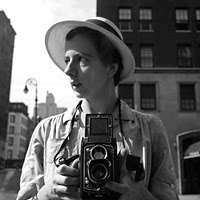
Starting in the 1950s, Vivian Maier shot over 100,000 pictures -- mostly of Chicago street scenes -- but she recently went to her grave with none of her work published or exhibited. In fact, about a third of her images were still on undeveloped rolls of film. Acquaintances knew her simply as a reclusive French immigrant who worked as a nanny, and who happened to take a lot of pictures. She discreetly and expertly chronicled Chicago life for decades, in candid shots clearly inspired by Henri Cartier-Bresson and his ilk, but apparently never showed the photos to anyone. They remained stashed in boxes.
The treasures came to light in almost storybook fashion -- bought at an antiques auction by a young real-estate agent who had no formal photography training, yet recognized something special about them. The auction house had acquired them from a storage facility that had sold them off when the bills weren't paid.
Though John Maloof had never even heard the term "street photography," his purchase proved serendipitous. He began scanning and developing the prints, a project that is still in progress. The photos inspired him to try his hand at taking pictures himself: "I bought her same camera [a Rolleiflex] and took to the same streets, soon to realize how difficult it was to make images of her caliber. I discovered the eye she had for photography through my own practice."
Maloof thought to Google Maier's name, which he found written on photo-lab envelopes, a year after his purchase. But by then it was too late. Her obituary was published the day before his search. (It made no mention whatsoever of her photography.)
However, from talking to families Maier worked for, and the camera shop she frequented, Maloof subsequently discovered that "Vivian came here from France in the early 1930's and worked in a sweat shop in New York when she was about 11 or 12... She was a socialist, a feminist, a movie critic, and a tell-it-like-it-is type of person. She learned English by going to theaters, which she loved. She wore a men's jacket, men's shoes and a large hat most of the time."
Maloof started a blog devoted to Vivian Maier and his quest to establish her reputation among the pantheon of celebrated mid-20th century street photographers. Local media recently picked up the story -- including WTTW TV's Chicago Tonight and Chicago Magazine.
The first exhibit of her work, at the Chicago Cultural Center -- 80 prints, both black-and-white and color -- goes on display from January 8 to April 3.
According to Maloof:
"There's still a good 90,000 negatives to scan and a few hundred B&W rolls to develop. Not to mention about 600 undeveloped color rolls. I've also safely archived over 3000 of her prints...Over the course of scanning her work I've discovered that Vivian traveled the world in 1959. She visited and photographed places like Egypt, Bangkok, Thailand, Taiwan, Vietnam, France, Italy, Indonesia...the list goes on. Something also notable is that she traveled alone."
A book of her work will be publshed this year, and Maloof is raising funds for a documentary, "Finding Vivian Maier."
Lots to look forward to. Critics have favorably compared her work to icons such as Lewis Hine, Berenice Abbott, Eugene Atget, Walker Evans, Robert Frank, Harry Callahan, Aaron Siskind, Diane Arbus, Lisette Model and Helen Levitt. Please take a look at Vivian Maier's oeuvre, and let us know if you think it's in the same league as images by those top street photographers of that era.
What’s in Your Bag with John Lehmann
-
John Lehmann is award winning photojournalist with the Globe and Mail in
Canada. John shares with Munetake Kayo what he carries while working, and
why he c...
Videographer job at University of Texas System
-
Matt Flores, a former colleague at the San Antonio Express-News, called me
today asking if I know anyone interested in a videographer position at the
Unive...




 Posts
Posts


